 I still haven't brought myself to read the final McBain 87th Precinct book, "Fiddlers", published shortly before his death. I don't want it ever to be over, this relationship with his cast of assorted cops. So instead I find myself dipping into the back catalogue from time to time, re-reading and enjoying as much as ever.
"Lullaby" is from a less than happy period in the existence of the 87th Precinct. I don't know if it mirrored some feeling of the author's that the world, or New York at least, wasn't what it had been. There is little of the levity that brightens the earlier books - Meyer Meyer, so fond of funny stories, is at his most antipathetic. I don't think I have ever before read him swear at and about a suspect. There is little interaction between Steve Carella (the nominal "lead man" of the 87th Precinct) and his wife, while his children are present only by mention of their existence. I wouldn't say that McBain was out of love with his characters, but I can't help that his characters were out of love with their lives. And it would take a good few years before the general tone of the series lightened up, when McBain decided that the redemption of New Yorkers could be exemplified by that of Ollie Weeks, the hitherto unloved (and unloveable) unreconstructed bigot.

Enough of the overall arc - what about this one book itself - how does it hang together after twenty years? Well, it is great to read again stories where the solution doesn't lie in Internet searches, DNA tests and mobile phone records, but in relentless, plodding, fruitless footwork and interviewing. McBain weaves together three separate storylines - the murder of a baby and baby-sitter, and double- and triple-crossing drug deal, and a soap-opera thread about a policewoman's fears of remaining in the job. Separately, each thread is slight, but together make for a well-paced read, with each storyline being cut into and away from in order to achieve dramatic tension. As a one-off read, it probably wouldn't make any new converts - too much depends on a familiarity with the cast, but a satisfying chapter in the 87th Precinct's story for any McBain fan.
Unputdownability : Lots of convenient chapter breaks make this a "cut-and-come-again" salad.
Classic crime, memorably portrayed.
 Stark is the pen-name crime writer Donald Westlake used for his darkest creation, the anti-hero Parker. You might remember Parker from Lee Marvin's portrayal in the '60s classic Point Blank, based on The Hunter (or, perhaps, from Mel Gibson's 1990s Payback - if so, bad luck).
 Darwyn Cooke has adapted the first Parker story into graphic novel format in a lovely, loose, cartoony duo-chrome pen-and-wash style reminiscent of early 60's advertising. But the world being sold here is no consumer dream, rather a tale of a falling out between thieves, betrayal, and implacable revenge. Cooke maintains a feeling of tension by regularly changing the rhythm of the story-telling - wordless action sequences alternating with crisp, noir-style dialogue, lengthy internal monologues, and single establishing shots.
To be sure, he has top-notch material to work with, but the skill he shows in creating the early sixties ambience, in keeping the reader turning the pag, and in conveying the emotional existences of the cast proves him a master of the sequntial-art story form. I'm off to search out the next volume.
Unputdownability: I know what's going to happen, but I want to see it now!
DEXTER IS BACK...
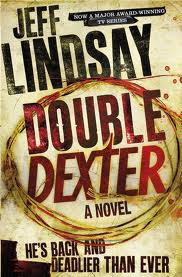 in the sixth volume of the series. Now, for anyone who watches the TV series (and it is excellent in its own way) don't expect to be able to pick up the books in random order and make any sense of them. After Season One (which followed the first Dexter novel faithfully) the two media split in completely separate universes (see "Walking Dead" for another example). So don't expect to see all the same characters, in the same relationships, or even in the same state of corporeal existence.
In this print universe, Dex is married, a recently-made father and uncle, and still enjoying his nights out with his Dark Passenger. Until, that is, someone witnesses him at work and, deciding that he is a fit person to rid the world of a monster, sets out on a mission to Do Dex Down, while Dexter himself struggles to find a way to locate his new adversary and put him out of the picture. At the same time, Dex's old nemesis, the severely abbreviated Sgt Doakes finds a new ally in his campaign to uncover out our hero's secret life.
Lindsay manages to ring the changes with each new Dexter novel. There is never a feeling of repetition, of re-using the same plots, or of having the character re-voice pet anecdotes, but instead new scenarios are imagined, and characters grow and change, as people (and even monsters) do. Already looking forward to book seven.
Unputdownability : Not now! Can't you see I'm reading?
Elmore Leonard is, perhaps, the best dialogue writer in American crime fiction. Couple this with the fact that he writes believable, engaging characters and intriguing plots and you have an author who bears reading and re-reading.
"Comfort to the Enemy" is a linked series of two short stories and a novella, watching lawman Carlos "Carl" Webster over a span over twenty or so years of his life. Beware the cover - this makes you expect some kind of "White Heat", "Little Caeser", Chicago gangster affair, but the contents are a long way from that. Encounters with wannabe Dillinger sidekicks, cattle rustlers, hard-working men who turn to bank robbery out of despair, a German PoW who escapes and then returns to camp almost at will. There's no detection, as such, very little in the way of knock-down, shoot 'em up gunplay, but a portrait of a man growing older and wiser in his job. Recommended.
An enforcer who works for a pair of London crime lords takes a little time off to look into the death of his brother. 
Everybody knows the film adaptation "Get Carter", where Michael Caine makes a superb job of playing the one-track anti-hero, his emotional range displayed by INCREASING THE VOLUME WHEN HE'S A BIT ANGRY. Nothing wrong with that. It was a great way of portraying the man with anger constantly seething an inch below the surface. If the film (for the most part, a faithful rendition of the book) is a nineteen-seventies take on the Jacobean Revenge tragedy, then the book is an attempt at literary noir - part Raymond Chandler, part Jim Thompson. Willis's descriptions of the almost-Scunthorpe townscape and population bear comparison with Chandler and Hammett, as does much of the dialogue, while the seediness, corruption, and inevitability of the tragedy bring to mind the best of Jim Thompson's novels (which reminds me - I must search out "The Getaway" for a 2010 read).
I first (and most recently) read this almost forty years ago. It is about its time, but is in no way a period piece, no more than "The Big Sleep". It won't be forty years before I read it again.

The late Donald Westlake back in his Richard Stark guise to present one last adventure with Parker. If you have never read any of the novels, you may remember Parker as being played by Lee Marvin in "Point Blank" (a terrific film)or by Mel Gibson in "Payback" (a pointless remake).
Westlake/Stark is one of a few writers to make a success out of writing under two separate identities. Ed MacBain/Evan Hunter springs to mind (and, indeed, must be the only instance of a writer collaborating with his alter-ego on a single novel), but whereas MacBain/Hunter wrote completely different genres (policers and literary), W/S splits between "caper" novels and the adventures of killer/thief Parker. In this one parker tries to recover the proceeds of an earlier novel, hampered at every turn by police, state troopers, rival gangsters, bounty hunters, and accomplices; just another working day for Parker.
Taut, pacy, never a wasted word; Stark by name and stark by execution.
I picked this up because of Pelecanos' connection to "The Wire", another one of those drama serials that American TV now does so well, and his influence on the show is made evident by his writing in this novel. His style can be clumsy, and he is prone to ignore the "Show-don't-tell" rule, but I guess that's a habit you fall into when writing for TV. But if you can get past these stylistic aggravations, he plots and does dialogue like a master, and his characters are more than a series of vocal tics and social mannerisms; they have depth and they are capable of change, and of surprising the reader.

Hooray! Charlie Parker is back! This is something like number eight in the Parker series and I cannot wait for numbers nine, ten, eleven...
The Parker books read with an authentic American tone; this could be any of the "C"s (Crais, Coben, Michael Connelly) but instead the author is Irish, and perhaps that's where the mystical undercurrent comes from. Sometime almost dead-straight private-eye/thrillers, every now and again Connolly delves into Parker's unusual spiritual situation. There's something more going on here than good versus evil on a mundane level.
It shouldn't work. It does work. That's the genius of John Connolly.
Oh, and do try his "Book of Lost Things", a wonderful fantasy novel.

Efficient and everything you have come to expect from JK. It won't change your life but then, hey, how many books do?

Don't go by the (admittedly entertaining) TV series; Dexter is a far darker character than the cheerful serial killer who makes such an unpleasant meal of cooking his breakfast. read the "Dexter" novels in sequence and find yourself cheering for the most unpleasant, yet simultaneously appealling, anti-heroes in current fiction.


As Mister Punch might say: "That's the way to do it". So beautifully, and sparely, written that it virtually provides the film script without any need for a screnwriter.


Goodbye to Burke and co.
Probably a just about due swansong - AV has written just about all there is to write about the family. I shall, nonetheless, miss them.


